Conventional
Photonic Interference
Computing similarity through the physics of light
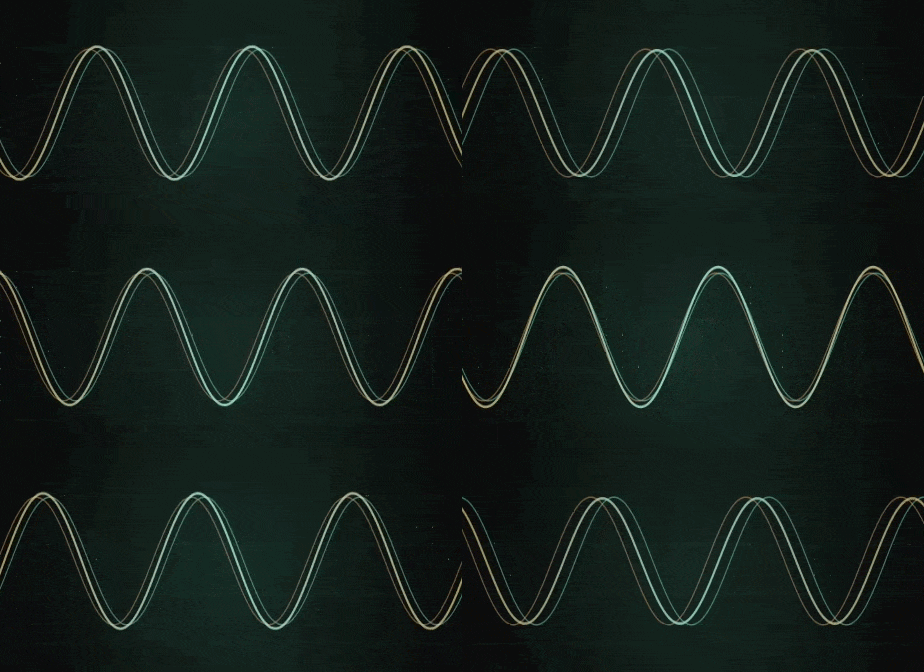
Phase-encoded optical signals are allowed to interfere. The resulting intensity pattern becomes the similarity output. No multiply-accumulate operations, and no arithmetic inside the compute event itself.
~30×
System-level energy reduction target
~235
fJ per attention weight, full photonic system
~230×
Optical-core limit when interface overhead is minimized
5
Execution stages: encode, propagate, constrain, interfere, detect
01 · Core idea
Similarity does not have to be computed arithmetically.
Modern AI systems spend enormous energy comparing representations: query to key, token to token, pattern to pattern. Photonic interference offers a different primitive. When phase-encoded signals meet inside stable coherence windows, their interference pattern naturally expresses similarity.
Arithmetic similarity
Electronic systems compute similarity through multiplication, accumulation, memory movement, and precision management. Energy scales with matrix size.
Optical arithmetic
Photonic GEMM
Many photonic systems recreate matrix multiplication with interferometric meshes. The substrate changes, but the arithmetic model remains.
HCE approach
Interference-native
Similarity is produced directly by wave interaction. The optical intensity distribution is the result; the electronics consume the measurement downstream.
Interactive phase alignment
Similarity: 100%
Aligned
Opposed
02 · Architecture
The relational computation finishes before digitization.
Electronics may schedule, encode, detect, normalize, or route the result. The comparison itself happens optically, inside a governed execution window.
01
<psi> Encode
Data representations are converted into phase relationships on optical carriers.
02
~~~ Propagate
Signals travel through multiple coherence-constrained optical channels.
03
[] Constrain
Phase drift, dispersion, and thermal effects are bounded within execution windows.
04
(+) Interfere
Signals combine physically. Constructive and destructive interference reveal similarity.
05
(o) Detect
The intensity pattern is measured and passed downstream. Computation is complete before digitization.
03 · AI application
Transformer attention becomes a physical event.
Transformer attention depends on repeated query-key similarity comparisons. The HCE photonic attention concept maps those comparisons into controlled optical interference cycles, governed by controller-defined coherence windows.
Attention request
→
Schedule window
→
Q/K encoding
→
Optical interference
→
Coherence check
→
Detection
→
Value integration
04 · Performance
Energy advantage comes from removing the multiply-accumulate loop.
Interference-native attention eliminates the arithmetic work inside the similarity operation. The optical core reaches approximately two orders of magnitude energy reduction per attention weight; system-level advantage depends on electronic interface overhead.
~7,000
fJ electronic baseline
Typical HBM and FP16 path per attention weight
~235
fJ photonic system
Including ADC, DAC, and amortized laser overhead
~30×
system advantage
At the full system level, not just the optical core
Photonic energy budget breakdown
10
20
100 fJ
50
50
The optical core, modulation plus propagation plus detection, accounts for roughly 13% of the photonic energy budget. The electronic interface dominates. Minimizing ADC, DAC, and laser overhead is the primary engineering lever for approaching the optical-core limit of roughly 230× advantage.
05 · Applications
Coherence is not assumed. It is governed.
Optical interference is powerful, but it must be stabilized. The platform model defines execution windows where phase, timing, temperature, and module readiness remain inside acceptable bounds.
Grid distribution
Relative phase change across channels.
bounded
Grid distribution
Relative phase change across channels.
bounded
Grid distribution
Relative phase change across channels.
bounded
Grid distribution
Relative phase change across channels.
bounded
Monitor PDs
Tap photodiodes for power and stability telemetry.
nominal
Timing skew
Pulse overlap and group-delay alignment.
corrected
Reference patterns
Known optical signatures are interrogated to detect drift before it affects computation.
Phase trim correction
Compensating adjustments close the loop through electro-optic actuators in the encoding stage.
Thermal anchoring
Temperature compensation is anchored to a sensitive indicator of system-wide thermal drift.
Rhythm sync
Calibration cycles occur during natural pauses when no attention computation is in progress.
03 · Performance envelope
What changes for the customer.
The target envelope is expressed against a conventional transformer of comparable VA rating and application grade. Values remain target specifications until qualified in the target hardware program.
Monte Carlo validation, mc_v127
Slope efficiency
+18.7%
Linewidth
-32.1%
Timing jitter
-21.5%
Linewidth reduction is especially relevant for attention computation: narrower linewidth corresponds to longer coherence length and more stable interference patterns over extended propagation.
07 · Scaling
Multi-head attention can scale through several optical routes.
Transformer models use multiple attention heads in parallel. The architecture supports spatial, wavelength, and time-division strategies, each with different engineering tradeoffs.
Spatial
Parallel waveguide groups provide concurrent head execution with no time overhead.
Tradeoff: linear area scaling
WDM
Wavelength-division multiplexing uses standard telecom components to carry many heads.
Tradeoff: dispersion management
TDM
Time-division multiplexing minimizes hardware by reusing a single rail set.
Tradeoff: linear area scaling
08 · Unified architecture
The same physical representation crosses memory and compute.
The dominant bottleneck in modern AI inference is not computation; it is data movement. A unified photonic representation reduces the representation boundary between cached state and the interference computation.
Conventional approach
Separate domains
01
Data stored as electronic charge states
02
Serialized onto a data bus
03
Transmitted to compute unit
04
Deserialized and converted
05
Computation performed
06
Result converted and stored back
HCE approach
Unified domain
01
Data stored as geometric phase structures
02
Phase-modified signal enters computation
03
Transmitted to compute unit
The data's physical form in memory, spatial variation in refractive index, is the same physical property used for computation. When the system retrieves cached data, light propagates through the storage medium and the resulting phase pattern enters the interference region directly.
09 · Safety-critical systems
Latency bounds come from physical topology, not scheduler promises.
Safety-critical applications demand provable worst-case execution time. The architecture bounds latency through known optical path length, deterministic controller cycles, and electro-optic encoding latency.
Hardware enforced
Topology, not policy
Components that introduce unbounded variance are physically excluded from the safety path. Software cannot override what hardware does not provide.
Bounded WCET
Provable latency
Worst-case execution time is bounded by optical propagation, controller cycle time, and electro-optic encoding latency.
Certification fit
Deterministic island
The safety-critical path is isolated by the physical graph, making the architecture legible to certification-governed markets.
Photonic reflex path
~1-10 ns
Electronic on-chip, SRAM
~1-10 µs
HBM / DRAM access
~50-200 µs
SSD access, with variance
50-2000+ µs
10 · Applications
Interference-native computation is most valuable where energy and latency both matter.
The combination of optical similarity, unified photonic memory, and hardware-enforced deterministic latency addresses requirements across certification-governed markets.
Autonomous vehicles
Sub-millisecond perception-to-action inference with bounded worst-case latency for collision avoidance and path planning.
Aerospace and defense
Deterministic AI inference for flight control, sensor fusion, and autonomous mission systems.
Medical devices
Latency-bounded diagnostic inference and closed-loop therapeutic systems.
Industrial control
Real-time predictive maintenance, process control, and robotic coordination with certified response time.
AI infrastructure
Lower-energy transformer inference and reduced memory-compute bottlenecks for long-context workloads.
02 · Architecture
The relational computation finishes before digitization.
Electronics may schedule, encode, detect, normalize, or route the result. The comparison itself happens optically, inside a governed execution window.
Phase 1
Single-triad proof of concept
Validate the interference-native attention mechanism with the simplest stable harmonic triad through waveguide fabrication, benchtop demonstration, and coherence characterization.
Phase 2
Multi-mode extension
Support task-specific mode selection across multiple coherence regimes, with each operation activating the configuration best matched to its requirements.
Phase 3
Unified photonic memory-compute
Integrate optically addressable memory tiles that store data as geometric phase structures and feed the photonic compute architecture directly.
Phase 4
Deterministic-latency inference engine
Build a hardware-enforced safety island with provable worst-case execution bounds for autonomous vehicles, aerospace, medical devices, and defense applications.
Phase 5
Scaled photonic tensor processing
Extend from attention acceleration to multi-unit coherence fabrics for workloads that exceed single-system capacity.
12 · Engage
Technical details are available under NDA.
HCE shares the full architectural specification, unified memory-compute design, deterministic-latency topology, and harmonic derivation framework with qualified technical partners under mutual non-disclosure.