Production systems still live around three-nines fidelity. Trusted-node relays add attack surfaces, repeater-heavy architectures struggle over intercontinental distances, and software consensus cannot verify whether a physical-layer signal has been spoofed.
──── Stable quantum operation across scales
The physics of stable quantum operation, across networks and processors.
Quantum systems fail at the boundary between scales. HCE treats that boundary as the design surface.
The same corridor architecture supports a five-nines quantum networking node and a parity-aware quantum computing platform, both built on a shared lattice of geometrically stable operating points that are derived rather than tuned.
Shared quantum substrate
qi
lattice
qc
Network fidelity
99.
9993%
five-nines target after phase-null calibration
Spoof detection
<2 ms
physical-layer parity inversion test
State lifetime
450 ms
seam-aware quantum memory baseline
T2 extension
2.4×
01 · The problem
Quantum systems are limited by operating points chosen for reach, not coherence.
Quantum networks and quantum processors look like different markets. Underneath, both run into the same constraint: the hardware reaches a setpoint, but the setpoint is not where coherence is naturally stable.
Quantum networks
Quantum computers
Coherence times remain short. Error correction consumes the qubit budget, calibration drift erases yesterday’s setpoints, and the commercial crossover point keeps moving as classical hardware improves.
02 · The approach
Hold coherence inside a corridor, then move state rail to rail.
HCE defines a set of operating ratios where physical coherence holds by structure. The corridor is narrow, divided into monitor rails, and stabilized through discrete micro-corrections rather than continuous feedback.
Odd-indexed rails act as stability anchors. Even-indexed rails act as transport channels. A state that needs to be held is placed where holding is natural; a state that needs to move traverses the channels between anchors. Mixing those roles is where conventional architectures lose coherence.
The correction layer is deterministic. Given the same input state and corridor position, it produces the same output every time, without seed-dependent variation and without the phase noise introduced by continuous PID-style correction.
Eight-rail coherence scaffold
roles shown, protected coordinates omitted
hold
move
hold
move
hold
move
hold
move
Odd rails stabilize.
Memory, idle states, and syndrome observation anchor to rails built for holding state.
Even rails transport.
Gates, entanglement distribution, and state migration move through rails built for transfer.
03 · Quantum internet
A repeater-light quantum node with physical-layer consensus.
The networking architecture combines a self-balancing entanglement fabric, hierarchical error correction, seam-aware quantum memory, and Proof-of-Resonance consensus into one deployable node architecture.
Entanglement fabric
A lemniscate topology places nodes at uniform angular intervals around two intersecting loops. Failure redistributes traffic across the remaining path geometry without expensive re-routing.
Seam-aware memory
Stored states are monitored by a Harmonic Confinement Score. When score drift approaches threshold, the controller migrates the state before decoherence sets in.
Proof-of-Resonance
Network state is validated through measurable harmonic alignment, not computational work or capital stake. Spoofing attempts are detected in under 2 milliseconds.
Lemniscate entanglement fabric
topology shown without protected node specification
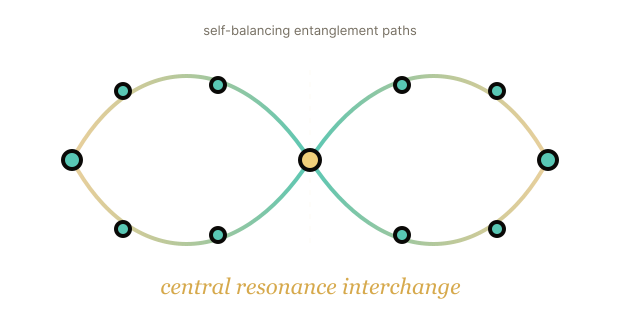
Bell state generation is validated at 98.7% fidelity on the experimental testbed. Monitor rails support long-distance entanglement distribution without introducing trusted-node relay risk.
Two operating modes, one node architecture
public-safe recreation of the coherence/bandwidth tradeoff figure
Coherence time
Bandwidth
Metro mode
450 ms
3.0 TB/s
Long-haul mode
810 ms
1.8 TB/s
The architecture can be tuned for bandwidth-critical metro links or coherence-critical long-haul links. The page-level 450 ms memory figure is the standard node setting; long-haul mode trades throughput for a longer coherence envelope.
04 · Quantum computing
Parity-aware control separates holding state from moving state.
The computing architecture applies the same corridor to qubits, gates, memory, cache, syndrome observation, and quantum-classical scheduling.
Parity-aware operation extends T2 coherence by 2.4× on otherwise identical hardware, with 22% noise reduction. A parity ablation, running the same hardware with the assignment scrambled, degrades performance significantly, confirming that the gain is architectural rather than incidental.
The dual-regime memory controller spans archival identity states and active operating states. Read and write timing align to natural coherence windows, reducing refresh-cycle energy and improving retention.
Dual-regime memory ladder
eight rails shown without protected coordinates
Classical and quantum subroutines schedule against the same coherence windows through a unified instruction-set extension, reducing impedance mismatch at quantum-classical boundaries.
05 · Why both
Networks and processors share the same coherence physics.
The same corridor that stabilizes a qubit also stabilizes a network channel. HCE treats quantum networking and quantum computing as one problem at different scales, not as separate domains joined by a lossy interface.
Shared calibration references
A processor and a networking node can use the same corridor references, which reduces handoff loss at the quantum-classical boundary and keeps state transfer aligned to the same coherence windows.
Shared correction primitives
The parity distinction that extends processor coherence also lets the networking correction layer self-sustain without an external classical interpretation step for every syndrome.
06 · Validation
The five-nines story is an error-budget story.
Standard operation reaches 99.91%. A photonic operating mode reduces thermal and two-photon loss, taking fidelity to 99.95%. The remaining gap is dominated by scale-crossing phase drift, which periodic phase-null calibration is designed to remove.
Five-nines error budget
public-safe relabel of FIG. C-6
At 99.95%
(500 ppm)
(500 ppm)
350 ppm
scale-crossing drift
75 ppm
thermal
40 ppm
detector
25 ppm
jitter
50×
reduction
At 99.9993% (<10 ppm)
3.5 ppm
scale drift
2.5 ppm
thermal
2.0 ppm
detector
1.0 ppm
jitter
Model comparison
ΔBIC -186.62
Strong preference for the corridor model over unconstrained alternatives.
Testbed
287 µs
T2* coherence, 6.4× over the 45 µs baseline.
Cross-domain verification matters because the same corridor ratios appear independently in plasma stability, pharmacological classification, and materials phase-transition data. The quantum architecture is not fitted in isolation; it operates inside a structure already visible across physical scales.
07 · Applications
Where stable quantum operation matters first.
Critical infrastructure
Aerospace telemetry, financial settlement, and grid synchronization need five-nines availability without trusted-node relay risk.
Contested networks
Physical-layer consensus and sub-2 ms spoof detection are built for adversarial environments.
Hybrid processors
Coherent handoff between computation and networking through a shared lattice abstraction.
Long-context AI
The identity and operating regimes map onto context-window storage and active attention paths.
Cryogenic flexibility
Temperature-adaptive band selection for 4K superconducting and 77K photonic environments.
08 · IP and status
A shared physical specification for networking and computing.
The quantum portfolio is the subject of pending U.S. patent applications assigned to HCE LLC, covering the Orchid QI-FRA module specification and addenda, the unified eight-rail dual-regime architecture, parity-aware quantum control, and a unified instruction-set extension for HCE-class hardware.
Licensing and deployment
HCE is open to licensing discussions with quantum hardware, networking, defense, and infrastructure partners evaluating deployable quantum nodes or parity-aware control architectures.
Government and co-development
Collaboration pathways include DARPA, ARPA-E, NSF SBIR, DOE programs, and prototype deployment on superconducting or photonic substrates.
09 · Engage
Request the quantum technical brief.
Evaluate the quantum internet node.
For networking, aerospace, defense, and infrastructure partners. The technical brief covers the entanglement fabric, five-nines error budget, memory migration protocol, and Proof-of-Resonance consensus.
Discuss the processor architecture.
For quantum hardware, hybrid-computing, and government R&D partners. The package covers parity-aware control, dual-regime memory, and the unified instruction-set extension.