Damage from sustained pressure oscillations can begin in under 100 milliseconds. Threshold monitoring often triggers seconds later.
──── Firmware-only combustion stability controller
Detect, identify, and correct combustion instability.
Sub-25 millisecond detection across six engine architectures, with mode-specific identification and continuous targeted correction.
No new sensors. No mechanical modifications. No training data required. The controller reads existing dynamic-pressure instrumentation, identifies the unstable acoustic mode, and applies micro-corrections while the engine continues to run.
Live harmonic telemetry model
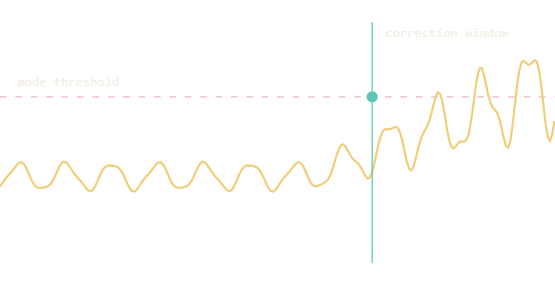
<25
milliseconds detection latency in Stage 1 testing
18/18
+0
new sensors or mechanical modifications required
6
01 · The problem
Combustion instability is detected late identified vaguely, and answered bluntly.
Current monitoring often relies on broadband pressure thresholds. It can detect that an instability exists, but usually not which acoustic mode is driving it or how to correct it without aborting the run.
Detection lag
No mode ID
A pressure spike says little about whether tangential, longitudinal, or coupled modes are actually destabilizing the chamber.
Shutdown bias
If the system cannot compute a targeted response, the safe operational action becomes fuel cut, test abort, or hardware inspection.
Expensive uncertainty
Late detection converts into rejected runs, unplanned teardown, lost diagnostic time, and avoidable risk across test and operational fleets.
02 · The approach
Read the harmonics. Identify the mode. Correct without shutting down.
The controller connects to existing dynamic pressure transducers and performs real-time harmonic decomposition of the pressure signal. Combustion-driven oscillations are separated from background noise, then mapped to mode-specific stability windows.
Detection thresholds, response gains, and stability windows are derived from the HCE framework rather than trained against a single engine dataset. The result is a firmware path that can be adapted across turbofans, turboshafts, gas turbines, liquid rockets, rotating detonation engines, and scramjets.
01
Shutdown bias
Read existing high-rate chamber or combustor pressure channels. No physical engine redesign is required.
02
Decompose
Split the signal into harmonic mode bands and separate instability growth from ordinary operating noise.
03
Classify
Identify which acoustic mode is crossing its stability boundary and how quickly it is evolving.
04
Correct
Apply a bounded fuel-metering micro-correction inside the prevalidated stability window.
03 · Validation
Two independent validation stages, both passed.
Stage one uses synthetic combustion signals with injected instabilities across six engine architectures. Stage two uses physics-based thermoacoustic regimes where instability emerges from the model rather than being injected.
01
Synthetic-signal validation across six engine architectures
Three mode families were injected into each signal. The controller had to detect onset, identify the mode, and compute a stability-window-valid correction.
LOX/H2 liquid rocket
0-25 ms
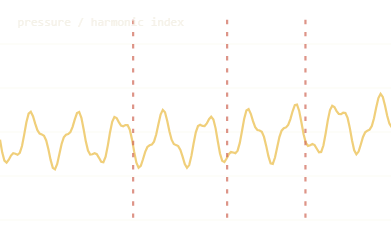
Pressure waveform with three instability onsets and harmonic stability index crossing threshold.
Mach 5 scramjet combustor
all modes
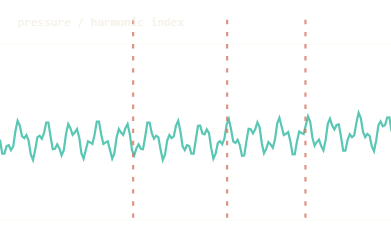
Higher-frequency, lower-amplitude operating regime with the same mode-specific detection protocol.
02
Physics-based thermoacoustic validation, instability not injected
A Rijke-tube style thermoacoustic model produces spontaneous transitions, intermittent bursting, and developed limit-cycle behavior from first principles.
Stable to unstable transition
30 ms
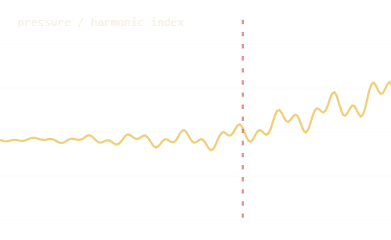
RMS envelope grows past baseline as heater power ramps; the controller detects spontaneous onset.
Developed limit cycle
continuous
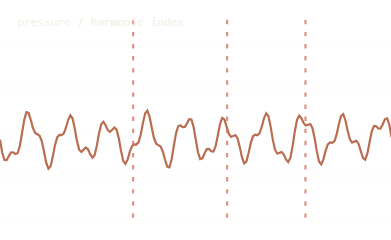
Sustained oscillation with continuous mode-specific monitoring and correction signal availability.
Validation scoreboard
Stage 1 and Stage 2 summary
Validation metric
Threshold
Result
Status
Events detected
18 required
18 / 18
pass
Maximum detection latency, Stage 1
≤ 500 ms
25 ms
pass
Maximum detection latency, Stage 2
≤ 500 ms
30 ms
pass
Coherence-resolution target met
≤ 0.001
100% of 5,000 pts
pass
Corrections inside stability window
all
18 / 18
pass
Events detected
all
3 / 3
pass
Headline operating claim
10x
finer coherence resolution than prior art
The controller reports mode-specific harmonic precision of +/-0.001 while preserving a firmware-only retrofit path for engines already instrumented with dynamic pressure measurement.
04 · Competitive position
The useful jump is not just detection. It is mode-specific correction .
Passive hardware, acoustic damping, and machine-learning prediction each address part of the instability problem. The HCE controller is positioned as a single firmware layer that detects, identifies, and computes a bounded correction.
Capability
Baffled injectors
Acoustic liners
ML prediction
HCE controller
Detection latency
N/A passive
N/A passive
1-2 sec
≤ 25 ms
Identifies mode
No
No
Limited
Yes
Computes correction
No
No
No
Yes
Engine continues running
Yes
Yes
Predicts only
Yes
Hardware modification
Moderate
Moderate
None
None
Training data required
N/A
N/A
Large dataset
None
Architecture portability
Per-engine tuning
Per-engine tuning
Retrain per engine
Single platform
Intellectual property
Two interlocking patent families filed with the USPTO.
The patent portfolio is described as covering controller architecture across system, method, and computer-readable-medium claim categories, spanning liquid rocket, rotating detonation, scramjet, and turbofan applications. The underlying mathematical framework remains separate from the patent disclosure.
05 · Engagement
Active conversations across defense, commercial, and MRO.
HCE is positioned for technical review with defense primes, supersonic aviation programs, and aerospace maintenance and overhaul organizations.
Lockheed Martin
SBIR quad chart under review
Submitted for technical review across propulsion-relevant business units.
Northrop Grumman
SBIR outreach submitted
Relevant to scramjet and hypersonic propulsion architectures covered by the portfolio.
Raytheon / RTX
Outreach and supplier registration
Engagement path framed around propulsion stability for integrated weapon systems.
Boom Supersonic
Partnership inquiry submitted
Combustion-stability relevance to Symphony and Superpower development programs.
06 · Engage
ATwo paths to a deeper
conversation.
Request a technical briefing under mutual NDA.
For defense primes, aerospace OEMs, MRO partners, and program offices evaluating combustion-stability control, firmware retrofit, or hypersonic propulsion risk.
Discuss the investment opportunity.
For accredited investors and early-stage funds interested in pre-seed exposure to firmware-only propulsion stability technology with an active IP position.